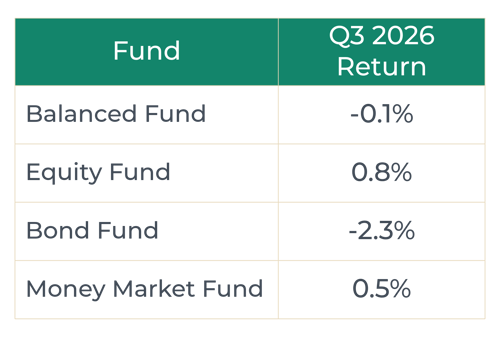
During the third quarter of 2026, investment returns were mixed as rising global interest rates weighed on fixed-income markets. The CSS Balanced Fund returned -0.1%, while the Equity Fund gained 0.8% and the Bond Fund declined 2.3%. Higher bond yields, which move inversely to bond prices, were the primary driver of negative fixed-income returns, while equity markets remained relatively resilient.
Market summary
Global financial markets remained resilient during the third quarter, supported by steady economic growth, healthy labour markets and strong corporate earnings. Consumer spending remained relatively stable, while continued investment in artificial intelligence (AI), digital infrastructure and data centres provided an important source of economic activity. However, geopolitical tensions, higher energy prices and uncertainty surrounding global trade continued to influence investor sentiment and inflation expectations.
Artificial intelligence remained a major driver of equity-market performance, although market leadership continued to broaden beyond the largest U.S. technology companies. Strong earnings growth across a wider range of industries helped support equity markets, including smaller U.S. companies. Businesses involved in semiconductor production, digital infrastructure and data centre expansion continued to benefit from significant investment in AI-related technologies. Nevertheless, elevated valuations in certain sectors raised questions about the sustainability of future growth expectations.
Canadian equities continued to benefit from solid corporate earnings, healthy balance sheets and shareholder-friendly policies, including dividends and share buybacks. Canada's relatively greater exposure to financials, energy and materials also provided diversification from technology-heavy global markets. However, uncertainty surrounding U.S. trade negotiations remained a potential challenge. International markets presented a mixed outlook, with European companies facing pressure from higher energy costs, while Japanese equities benefited from corporate reforms and continued investment in technology. Emerging markets continued to offer opportunities in AI-related industries, although China's economic challenges remained a concern.
Fixed-income markets experienced continued interest-rate volatility as central banks balanced inflation concerns against the need to support economic growth. Higher energy prices contributed to renewed inflation concerns, while uncertainty surrounding the direction of interest rates influenced government bond yields. Corporate bonds remained supported by strong fundamentals and relatively low default rates, although credit spreads remained historically tight, offering limited additional compensation for risk. Despite these challenges, higher bond yields continued to provide attractive income opportunities for investors.
Alternative investments continued to provide important diversification benefits. Commercial real estate markets showed signs of stabilization, with improving conditions in several regions following earlier valuation adjustments. Infrastructure investments remained supported by long-term demand for electricity generation, energy storage and digital infrastructure. These investments continued to offer opportunities for stable income and long-term growth, complementing traditional equities and fixed income within diversified portfolios .
Read the full Q3 2026 Quarterly Investment Report

Topics: Quarterly Investment Report