

Earlier this summer, CSS held its annual State of the Plan webinar giving members a more in-depth look at the Plan’s investment performance in 2025.
Leading the discussion on CSS’ investment performance was Derek Bissonnette, Director, Investments and Financial Management. Derek joined our team in December 2025. He has over 20 years’ experience in financial investments and has worked for Aon, Greystone and Plannera. His leadership philosophy is driven by purpose, curiosity and collaboration.
The investment performance overview focused on four key areas:
- A changing world
- How CSS navigated it
- Performance of the Balanced Fund
- Positioning CSS for the future
Act 1: A changing world
In early 2025, a new U.S. administration took office leading to new uncertainty in the financial markets. Soon after, the U.S. President introduced tariffs on Canada, Mexico and China. This move prompted strong reactions in Canada and around the world. It also affected financial markets and reinforced the importance of diversification.
We’ll look at the three key factors impacting the markets in 2025.
First, there was a shift in the markets. U.S. equity markets led performance in 2023 and 2024. However, in 2025, Canadian and international equities outperformed U.S. equities on an absolute return basis.
Second, there were a few surprises in the equities market. One of the biggest market surprises in 2025 was the strong performance of precious metals, particularly gold, which reached a record high. Gold rose from approximately US$2,600 per ounce to more than US$4,300 per ounce.
Derek noted that seven large technology-focused companies were responsible for roughly half of the S&P 500's performance in 2025. This was driven by strong financial results and continued innovation. These seven stocks are often referred to as the Magnificent Seven. They include Alphabet, Amazon, Apple, Meta Platforms, Microsoft, NVIDIA, and Tesla.
Most of these seven companies continue to pursue opportunities driven by artificial intelligence (AI). As a result, AI remains a major driver of market activity and investment flows.
“Over the long term, most investors continue to look for companies with strong fundamentals, attractive valuations, durable competitive advantages and sustainable earnings growth,” he reminded us.
And finally, valuations are still important. A valuation is the process of estimating what a company is worth. While valuations cannot predict short-term market movements, they can influence long-term return expectations. Therefore, higher valuations may limit long-term return expectations, even for strong, high-quality companies.
“After many years of strong returns in the U.S. equities market, investors began asking whether some parts of the market had become too expensive relative to history – meaning investors were paying significantly more than a company’s estimated value,” Derek noted.
Rather than focusing solely on traditional economic indicators, Derek suggested that market sentiment and investment decisions in 2025 could be understood through five key themes. These included valuations, interest rates, inflation, economic growth, and market concentration.
Because risks and opportunities vary across asset classes, Derek reinforced the value of CSS' diversified investment approach. Diversification helps position the CSS portfolio to capture opportunities, while managing risk across changing market conditions.
Act 2: How CSS navigated shifting markets in 2025
Strong markets reinforced the importance of maintaining a disciplined, long-term approach in 2025. CSS’ core investment beliefs within its Investment Policy provided guidance. This helped ensure investment decisions were based on long-term objectives rather than short-term market trends.
CSS used four key tactics to navigate the shifting markets in 2025.
First, CSS ensured its investment foundation was strong. Every house needs a strong foundation. This holds true for any long-term investment portfolio. CSS believes asset allocation is the foundation of long-term investment success and backed-up by industry research.
Next, CSS used the right mix of building blocks. Asset allocation means deciding how much of the portfolio to invest in each asset class. This includes equities, fixed income, real estate and infrastructure. Choosing and managing the asset mix helped CSS balance returns with risk management.
The allocation of assets for the CSS Balanced Fund in 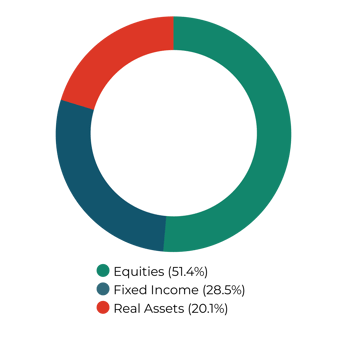 2025 is shown in the graph.
Thirdly, CSS diversified its CSS asset allocation. Often, we’re told not to put all our eggs in one basket. This concept applies to any successful investment strategy.
“Diversification is not only about maximizing returns in every market environment. It’s also about improving the likelihood of successful outcomes across many different environments,” Derek reminded members.
And finally, CSS managed investment risk. In 2025, CSS focused on managing a wide range of risks. Derek expanded on this by saying, “Some of the risks we consider when we’re building a portfolio are market risk, interest rate risk, concentration risk, currency risk, and behavioural risk.” The goal wasn’t to eliminate risk. Instead, CSS diversified its portfolios to withstand a range of market conditions.
Act 3: Performance of the Balanced Fund
Next, Derek discussed the Balanced Fund’s performance in 2025 and its connection to CSS’ long-term investment approach. 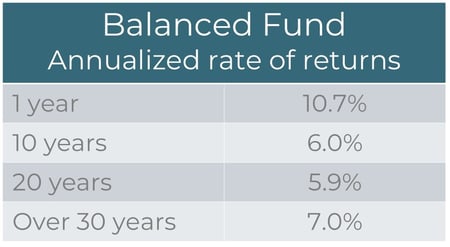
The Balanced Fund earned a strong 10.7% return in 2025. This was below its policy benchmark return of 13.8%. The policy benchmark provides a reference point based on the Fund’s long-term asset mix and the market indexes associated with each asset class. The difference in 2025 was largely due to the continued strength of large U.S. technology companies noted earlier.
Longer-term results continued to show the value of staying invested. The Fund’s annualized returns were 6.0% over 10 years, 5.9% over 20 years and 7.0% over 30 years.
Act 4: Positioning CSS for the future
In his final section, Derek highlighted the lessons CSS learned in 2025. He then explained how CSS is positioning the Plan for the future.
Lessons learned in 2025
- Market leadership can remain narrow for longer than expected. This was seen in the small number of large U.S. technology companies (i.e., the Magnificent Seven) that continued to drive a significant share of global equity returns.
- Diversified portfolios may lag when markets are led by a small number of companies or sectors. However, diversification remains important for managing risk and uncertainty over time.
- Valuations still matter. Paying attention to valuations supports a disciplined, long-term investment approach.
- The future rarely looks like the past. The best-performing asset classes, sectors and regions often change over time.
CSS’ strategic portfolio review
In 2024, CSS completed a portfolio study to assess whether the portfolio was still aligned with member objectives and long-term expectations. From there, CSS made measured changes to strengthen its investment program, including:
- adding GMO Quality U.S. Equity;
- reducing Scientific Beta;
- completing an emerging markets manager search;
- starting a review of total public equity; and
- continuing education on private markets and hedge funds.
Positioning for the future
Geopolitical and policy uncertainty, particularly in the United States, influenced the markets in 2025. These developments reinforced the importance of diversification.
In response, CSS leadership began refining the portfolio while maintaining its long-term investment strategy. The focus in 2026 has been on strengthening diversification across the public equity portfolio, so members are better positioned for a wide range of market environments over the long term.
CSS’ positioning focused on these four areas:
-
Valuations. CSS continues to favour quality companies at reasonable valuations. This approach supports a consistent long-term investment approach.
-
Diversification within equities. CSS continues to invest across Canadian, U.S., international and emerging markets. In 2026, CSS began reviewing how these equity investments are structured. There was a focus on improving diversification and reducing reliance on any single market, investment style or source of return.
-
Diversification through fixed income. CSS maintains exposure to both Canadian and global fixed income as an important part of a diversified portfolio. Investing across different countries, interest-rate environments and credit markets provides additional sources of return and can help reduce overall portfolio risk when equity markets are volatile.
-
Real assets. Exposure to real assets, including real estate and infrastructure, is an important part of CSS’ diversified investment approach. These investments can provide consistent income. They also provide a different source of return from traditional stocks and bonds and help build a more resilient long-term portfolio. Derek went on to say, “There’s a potential benefit to being in certain asset classes when you’re in a high inflation environment. This includes asset classes like direct real estate and direct infrastructure, which CSS has exposure to.”
Final takeaway
In 2025, markets changed quickly and there was a lot of uncertainty. Through it all, CSS stayed focused on its long-term investment approach. The Balanced Fund earned a strong 10.7% return, helped by a mix of investments such as stocks, bonds, real estate and infrastructure. This diversified approach helps manage risk and keeps the Plan well positioned for different market conditions in the future.
You can watch the complete State of the Plan webinar recording below.
















.png)